
For decades, the image of human evolution has been depicted as a linear and progressive process: an ape-like ancestor gradually transforming step by step into a triumphant Homo sapiens, like this:
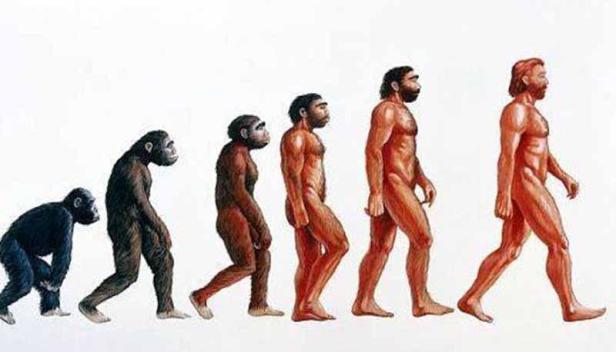
This vision, often illustrated with a white male at the end of the path, reflects a comforting yet incorrect notion. Modern science, however, tells us a far more intricate story, filled with plurality and unexpected connections.
Not a Line, but an Evolutionary Bush
Human evolution does not follow a straight trajectory; instead, it unfolds like a bush with many branches. Each branch represents a human group, many of which went extinct without leaving descendants. Homo sapiens is just one small twig on this bush (marked with a red arrow in the diagram below), sharing the evolutionary tree with chimpanzees, gorillas, and orangutans—our closest relatives.
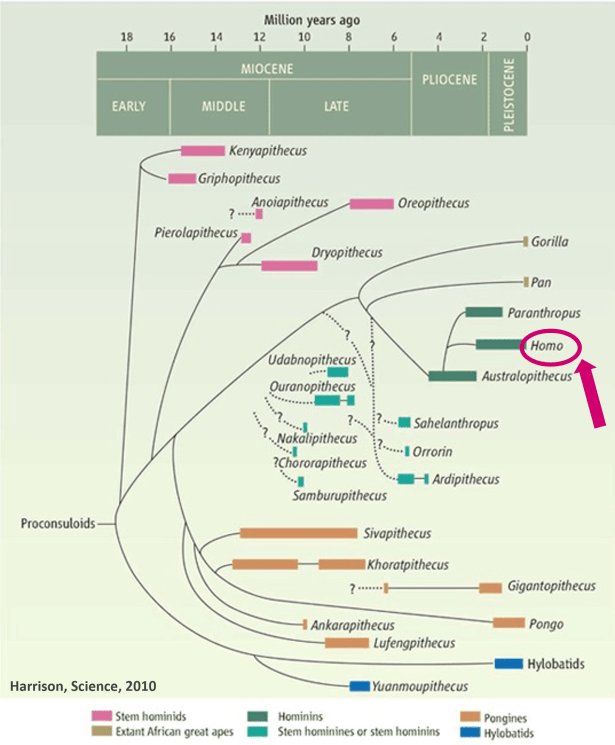
This perspective highlights how incomplete our understanding still is. Many evolutionary connections remain shrouded in mystery, but one thing is certain: our history is characterized by extraordinary biodiversity.
A Planet Populated by Human Species
As recently as 50,000 years ago—a blink in evolutionary terms—the Earth was home to at least five human species coexisting. Homo sapiens lived alongside Neanderthals in Europe, Homo floresiensis in Indonesia, Denisovans in Asia, and likely other yet-to-be-discovered species.
The idea of coexisting with other human species is difficult to conceive today, accustomed as we are to evolutionary solitude. However, this solitude is a recent phenomenon, beginning with the extinction of other species—a process in which Homo sapiens played a decisive role through competition and interbreeding.
Migrations and Adaptability
Homo sapiens is a quintessentially migratory species. The first major migrations, around 2 million years ago, began from the Horn of Africa, crossing the Sahara and Mediterranean to reach Eurasia. This mobility, combined with remarkable evolutionary adaptability, enabled us to thrive in diverse ecosystems, from deserts to tundras. Tens of thousands of years ago, the paleocoastlines were different, and for long periods, Africa and Asia were connected to a supercontinent that included the Americas, allowing movement without crossing water barriers from South Africa to South America.
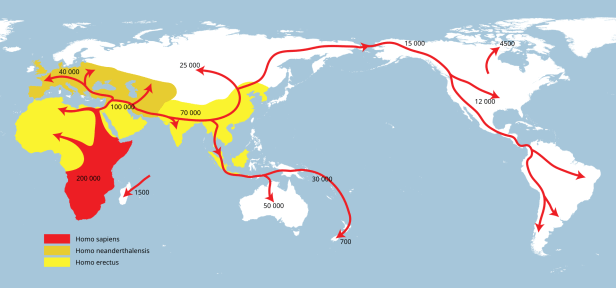
The migration routes of our ancestors mirror modern migration patterns, underscoring a deep connection between ancient history and contemporary phenomena.
Encounters Between Human Species
Around 40,000 years ago, Homo sapiens arrived in Europe, already inhabited by Neanderthals. For several millennia, the two species coexisted, forging relationships that were not solely competitive. Genetic evidence demonstrates interbreeding, and today, a small percentage of the genome in non-African populations contains Neanderthal DNA.
This hybridization enriched our species, for instance, enhancing immune resistance. However, the demographic and territorial pressures exerted by Homo sapiens contributed to the gradual extinction of Neanderthals, who survived until around 28,000 years ago.
Such interspecies interactions were not confined to Europe. On the island of Flores in Indonesia, Homo sapiens encountered another human species: Homo floresiensis. This species, standing barely over a meter tall, evolved in isolation, undergoing a phenomenon known as insular dwarfism. Despite their significantly smaller brains, the Floresiensis demonstrated remarkable technological and cultural abilities, persisting until about 12,000 years ago—a timeframe so recent that some remains are not fully fossilized.
Neoteny: What Makes Us Unique and Solitary
A crucial aspect of Homo sapiens’ evolution is neoteny—the prolongation of the period of parental dependency. For example, Neanderthals reached adulthood approximately two and a half years earlier than us. A large brain is metabolically expensive, and raising fragile offspring for many years demands significant parental investment. This innovation likely required substantial changes in social organization, such as the ability to protect and support young within a group for extended periods.
However, neoteny also brought immense advantages. It extended periods of learning, play, and imitation, fostering the development of extraordinary cognitive abilities. Our brain, unique in its kind, develops significantly after birth—an adaptation linked to the mechanical limitations of the birth canal.
This postnatal growth gave our brain a more rounded shape, with pronounced vertical development that increased space for the prefrontal cortex, the seat of higher cognitive functions.
A Story of Resilience and Interconnections
For most of our history, we were not dominant hunters but skilled scavengers, retrieving the remains of prey killed by stronger predators. This behavior allowed us to incorporate essential proteins into our diet without taking significant risks. This past as prey has shaped many of our social and behavioral adaptations.
Our story, therefore, is a lesson in humility—a narrative of encounters, adaptations, and resilience. We are the product of collaborations, hybridizations, and compromises with other human forms, surviving only due to a complex interplay of biological, social, and environmental factors. Understanding this history is essential not only to learn about our past but also to reflect on how we interact today with our planet and other living species.

