
Imagine the scene. It is the year one million A.D. Humanity (or whatever it has become by then) makes a colossal discovery: a time machine. Such an advanced civilization might choose to take the most revolutionary step imaginable: travelling back to our era to reveal the secret of this technology. A hand from the future reaching into the past.
And yet, despite the fascination of this idea, contemporary physics poses a more uncomfortable question: even if it were possible to build a time machine in the distant future, could they really travel all the way back to us?
To answer this, we need to explore several key concepts from Einstein’s relativity, wormholes, time-travel paradoxes, and Stephen Hawking’s famous conjecture that the universe itself “protects” its own chronology. We will do so using examples and images that make the ideas easier to grasp.
General relativity: the structure of time is not rigid
General relativity, formulated by Albert Einstein in 1915, is the theory that describes gravity in its deepest form. The central idea is that space and time are not separate, rigid entities, but together form a flexible structure known as spacetime. This structure can deform in the presence of mass or energy: a star, a planet, or even a black hole “bends” the spacetime around it.
A surprising consequence of this theory is that time can flow at different speeds depending on where we are or how fast we are moving. Clocks near a strong gravitational field run more slowly than those farther away. This is not a theoretical guess: it has been verified multiple times, even with atomic clocks placed at different altitudes on Earth.
This flexibility of time is what allows, at least mathematically, the existence of paths that might bring a traveler back into their own past. This does not mean such paths are practically realizable: mathematics allows many solutions, but nature only permits those that are physically possible. Nevertheless, the theoretical opening exists, and from this the speculation about time travel arises.
Wormholes: theoretical tunnels between distant regions of spacetime
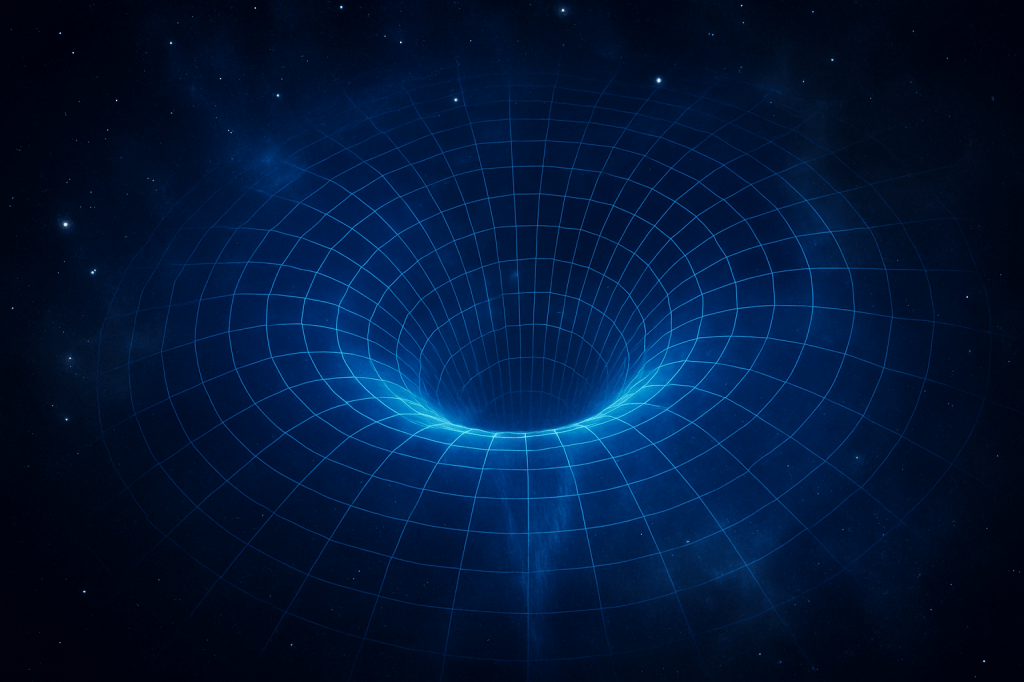
Imagine folding a sheet of paper so that two distant points touch. A wormhole (or Einstein–Rosen bridge) is something similar: a connection, predicted mathematically by general relativity, that links two points in spacetime directly and over a very short distance. If they existed, they could allow almost instantaneous travel from one place to another, and even from one time to another.
To turn a wormhole into a time machine, one would use time dilation: if one “mouth” of the wormhole were accelerated to speeds close to that of light, or placed near a black hole, its passage of time would slow compared to the other mouth. Then, once the two mouths are brought together in space again, it would be possible to enter one and exit the other at an earlier moment.
The problem is that wormholes, though theoretically possible, would be extremely unstable. Without a form of “exotic” matter containing negative energy, they would collapse instantly, blocking any passage. Negative energy is not something we can produce or manipulate on a large scale* (see below). Moreover, quantum effects could generate huge fluctuations of energy precisely when the wormhole is about to turn into a time machine, destroying it instantly. It is as if nature, while allowing the mathematical possibility, always finds a way to prevent the practical realization.
Closed timelike curves: paths that “loop back”
A closed timelike curve (CTC) is a path through spacetime that begins at a point and, by following it continuously, brings you back to that same point… but in your own past. It is like traveling around a racetrack, except the track is embedded in a warped time. The rotating universe proposed by Kurt Gödel in the 1940s is one theoretical example: in that universe, spacetime would rotate in such a way that it drags time lines along, creating paths that loop back into the past.
If such curves existed in our universe, they would allow time travel without wormholes. But here too, problems arise: the real universe does not appear to have the properties needed to generate closed timelike curves, nor have we observed any hints of cosmic-scale rotation. These solutions remain mathematical curiosities more than physical possibilities.
The bootstrap paradox: information with no origin
The bootstrap paradox is one of the strangest ideas linked to time travel. It occurs when an object or piece of information exists without having a true origin. Imagine a simple case: an inventor in the future builds a time machine, travels to the past, and gives their younger self the blueprints. The young inventor uses those blueprints to build the machine and, years later, travels back to give the same plans to their past self.
The fundamental question becomes: who wrote the blueprints? No one. They exist because they are recycled through time. But physics is built on the idea that every effect must have a cause. The bootstrap paradox breaks this rule, creating objects or information “without ancestry,” like books, tools, or technologies that were never invented by anyone. This is one of the main reasons many physicists believe travel to the past must be impossible.
The Chronology Protection Conjecture: nature avoids paradoxes
To resolve these issues elegantly, Stephen Hawking proposed the Chronology Protection Conjecture in the 1990s. The idea is that the laws of physics prevent anyone from building a time machine that allows travel into the past. Not for philosophical reasons, but because quantum phenomena would generate enormous energy fluctuations in the region where a closed time-like curve is about to form. These fluctuations would destroy the wormhole or structure before it could become a working time machine.
Hawking did not provide a definitive proof, but he showed that nature’s behavior seems to “defend” temporal coherence. It is as if the universe had a self-defense mechanism against paradoxes: it permits time dilation, spacetime distortions, and even theoretical tunnels… but it does not allow alterations to the past.
The paradox of the absence of visitors from the future
There is also a very simple observation, more logical than scientific: if in the future someone invents a time machine capable of returning to periods before its creation, then we should already have the possibility of meeting travelers from the future today. The fact that this does not happen is not definitive proof, but it is certainly a clue. Three explanations exist:
- Time travel to the past is physically impossible.
- It is possible to travel back in time, but only to the moment when the first time machine is activated.
- Travelling to the past does not modify our timeline, but creates a new one, so any visitors would never reach our own history.
The first explanation is the simplest; the other two, though intriguing, have no experimental support.
Conclusion: the past remains out of reach
As intriguing as it is to imagine a visitor from the future handing us the plans for a time machine, modern physics suggests this is extremely unlikely. The theoretical solutions that seem to allow travel into the past require conditions and forms of matter that do not appear to exist in our universe. Causality paradoxes show that such journeys lead to deep contradictions. And the Chronology Protection Conjecture suggests that the universe actively prevents any attempt to build a functioning time machine.
Ultimately, even though mathematics lets us glimpse surprising possibilities, nature seems to be telling us that the past is a chapter already written, something we can observe but never reach.
*Negative energy: what does it really mean?
In classical physics, energy is always positive: you cannot have less energy than the vacuum. In quantum physics, however, the vacuum is not truly empty: it is filled with constant fluctuations of fields and energies that appear and disappear very quickly. Within this quantum “boiling,” it is possible under certain conditions for a region to have less energy than the normal value of the vacuum. This is what we call negative energy. It is as if, on a lake constantly rippled by waves, a small hollow momentarily formed that dips below the average water level.
The most famous phenomenon in which negative energy appears is the Casimir effect, which has been measured in the laboratory. If two metal plates are placed extremely close together, the space between them cannot contain all the possible quantum fluctuations. This creates a higher pressure outside than inside, pushing the plates together. In the region between them, the vacuum energy becomes lower than normal, meaning negative relative to the usual reference.
 Trust in Science