
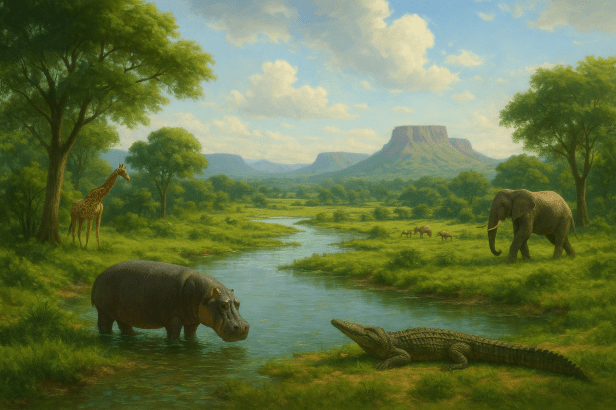
Today the Sahara evokes images of dunes, relentless heat, and arid silence. Yet between about 11,000 and 5,000 years ago, this vast region was the opposite of what we know: a mosaic of savannas, immense lakes, perennial rivers, and scattered woodlands. It was a vibrant landscape populated by hippos, giraffes, elephants, crocodiles, and human communities thriving thanks to abundant water. This extraordinary climatic phase is known as the African Humid Period, or more evocatively, the Green Sahara.
Testimonies of a fertile past
Evidence for this transformation is abundant and consistent. Archaeologists and paleontologists have uncovered remains of large mammals in areas that are now utterly desertic, from Mali to Algeria. Lake sediments contain clays, pollen from humid-zone vegetation, and freshwater mollusk shells, unmistakable signs of lakes and wetlands.
Even more evocative are the rock paintings of Tassili n’Ajjer, the Acacus, and the Tibesti: herds grazing, people swimming, canoes, and water-related rituals. They are visual diaries of a Sahara that no longer exists.
The giant of water: Mega-Lake Chad
Among the most spectacular features of the Green Sahara was Mega-Lake Chad, a lake that at its greatest extent reached an area comparable to modern Germany. It plunged to depths of more than 100 meters and occupied a wide region between 10° and 18° north.
Ancient rivers, now dry, flowed into it, including the paleo-river Tamanrasset, which once drained the western Sahara toward the Atlantic. Geomorphological and sedimentological studies have identified fossil beaches, tombolos, deltas, and wave-cut terraces, allowing researchers to reconstruct the lake’s evolution.
The science behind the reconstruction
Rebuilding the story of the Green Sahara has been possible thanks to several advanced techniques. Paleoclimatologist Françoise Gasse played a pioneering role by analyzing African lake sediments to trace climatic variations during the Quaternary.
In recent decades, satellite remote sensing, geomorphology, optically stimulated luminescence (OSL) dating, and high-resolution climate models have enabled scientists to map ancient shorelines and determine past precipitation patterns. These studies show that humid conditions began to take shape around 15,000 years ago, peaked roughly 11,500 years ago, and persisted until about 5,000 years ago.
Why the Sahara turned green
This transformation was driven by the Milanković cycles: about 10,000 years ago, the Northern Hemisphere received greater summer solar radiation, which strengthened the African monsoon and pushed rainfall far north of today’s Sahel zone.
Once vegetation became established, it further enhanced rainfall, creating a positive feedback loop that stabilized a wet ecosystem.
The return of the desert
Around 5,000 years ago, everything began to change. Gradual shifts in Earth’s orbit weakened the monsoon. Rainfall became irregular, vegetation collapsed, and desertification advanced rapidly.
Between 2550 and 2200 BCE, the great lakes dried up, wet-zone fauna disappeared, and human groups migrated toward more fertile regions, especially along the Nile—movements that contributed to the rise of early Egyptian civilization.
The disappearance of Mega-Lake Chad also had geophysical effects: the loss of water mass caused slight isostatic uplift of the Earth’s crust, subtly altering the region’s topography.
Human traces
The lives of the people who inhabited the Green Sahara emerge with surprising clarity. Sediments from Lake Yoa in northern Chad have preserved a continuous archive of the past 6,000 years: pollen, minerals, microfossils, and isotopic signatures reveal the annual evolution of climate and vegetation.
The inhabitants of this humid Sahara built settlements, raised livestock, navigated expansive bodies of water, and produced extensive rock art that reflects a deep bond with the landscape.
A look toward the future
Knowledge of the Green Sahara does not stem from speculation but from sedimentology, fossil shorelines, climate models, and archaeological findings. Reconstructing this past helps us better understand the dynamics of Earth’s climate and the fragility of ecosystems.
Some models suggest that the Sahara could become green again in a distant future, aligned with upcoming astronomical cycles; however, global warming complicates these projections.
The story of the Green Sahara reminds us that climate can shift dramatically in surprisingly short periods, and that the past is not merely a memory—it is a lens through which we can interpret the present and prepare for the future.
 Trust in Science