
The observation is dramatic but recurring: many societies end up handing power to individuals who seem — for cruelty, incompetence, or immorality — the worst among us. What explains this tendency?
Philosophical premise: fear, order, and the social contract
Since classical political philosophy we find two complementary intuitions. Thomas Hobbes observed that, left in a state of nature without authoritarian power, human beings live in a condition of “war of all against all”: to escape this condition they make a pact and delegate power to a strong sovereign (the Leviathan) who imposes order. In times of collective insecurity, therefore, the preference for a “strong” leader, even a harsh one, is rationalizable: it is the price paid for group security and survival.
Nietzsche and other philosophical traditions, on the other hand, remind us that power attracts people with a strong will to dominate; and society tends to legitimize them when it itself rewards success and control. From this point of view, choosing a “bad” leader may be the joint result of cultural expectations (esteem for power) and institutional backwardness (weak checks on leaders).
Konrad Lorenz’s insight: aggression as a channeled instinct
Konrad Lorenz, an ethologist, proposed that many forms of social behavior are rooted in innate predispositions which, in humans, are expressed in culturally modulated ways. In particular, he studied aggression as a biological component of the social animal: intraspecific aggression (i.e. among members of the same species) is a mechanism that regulates resources, hierarchies, and clan defense. Lorenz highlighted how environmental stimuli and ritualized signals can trigger or inhibit innate aggressive responses.
Translated to humans: the ability to inflict violence or intimidate can be perceived as a “competence” useful in conflict contexts. If a society is structurally oriented toward intergroup competition (war, colonization, conquest), then a leader who displays “effective” aggression will be rewarded because he is perceived as able to defend or expand the group. Lorenz himself does not morally justify violence, but describes mechanisms that explain why violence may be selected as a useful trait in evolutionary or cultural contexts.
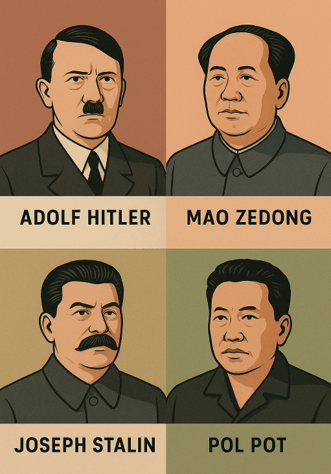
A practical example is 20th-century Europe. After industrialization had “tamed” most natural challenges, violence shifted within the species, exploding in two world wars. In that context, leaders like Hitler or Stalin were perceived as “necessary” because they were able to crush both internal and external enemies. Cruelty was not a defect, but the sign of their “effectiveness.”
From supremacy over other species to intra-human competition: a change of target
The human species has accumulated knowledge and technologies that drastically reduced threats posed by other species. This shift has two major effects:
- Shift in competition: where once the “enemy” was nature and animals, today most significant threats come from other humans (resources, status, political power). Adaptive strategies that once rewarded external military strength now reorient toward the ability to compete with members of the same species.
- Amplification of social weapons: technology, bureaucracy, and organization allow a charismatic and unscrupulous person to concentrate on controlling other humans — not only through physical confrontation but also through manipulation, propaganda, and institutions. Thus the “leader skilled at eliminating other men” is not only a warlike figure: he is also one who can neutralize political opponents, discredit rivals, monopolize power.
From here arises the paradoxical preference for “anti-human” leaders: in contexts perceived as conflictual or politically survivalist, those who best “eliminate” adversaries (efficiently and unscrupulously) are rewarded as a guarantee of victory.
Social and cognitive psychology: how the worst are favored
Several psychological mechanisms explain why masses and elites alike may abdicate moral common sense when choosing leaders:
- Threat bias and preference for authority: under real or perceived threat, people tend to prefer strong authorities (shock effect). Fear reduces critical thinking and increases obedience.
- Charisma effect and simplicity of narratives: aggressive leaders often offer simple stories (external enemy, clear-cut solutions). The human mind prefers neat explanations under cognitive stress.
- Scapegoating and group cohesion: by designating an internal or external enemy, the leader strengthens group identity. Followers willing to sacrifice ethics for belonging and security tend to support even those who break norms.
- Confirmation bias and information silos: when institutions or media are penetrated by particular interests, the population receives filtered information that presents the leader as indispensable.
- Elite selection and competition pressure: in real selection procedures (war, political competition) those who use unscrupulous means often have competitive advantages — and thus the “worst” can emerge as winner.
The role of institutions and cultural context
It is crucial to remember that the selection of leaders is not an inevitable biological destiny. Institutions that limit personal power (checks and balances, laws, free press, civic education) drastically reduce the likelihood that criminal or foolish individuals gain and hold power. Cultures that value transparency, responsibility, and pluralism reward cooperative skills rather than mere strength.
Lorenz explains that natural impulses can be channeled: the same innate aggression can be transformed into community defense, symbolic regulation, or non-lethal rituals rather than extermination. The difference is made by moral codes and institutional design.
Preventing tyranny requires cultural intelligence, not just strength
The paradox of choosing ruthless leaders in a species that has defeated all others is real but not inevitable. The causes are complex: residues of ethological balancing, defense needs in an environment dominated by intra-human conflicts, cognitive biases, and mechanisms of social selection. The lesson, however, is practical: if we do not want the “best eliminator of men” to become leader, we must build institutions that defuse brute force as the only criterion of legitimacy, promote critical education, responsibility, and ritualized and symbolic forms of competition that reward not cruelty but the ability to cooperate and govern.
In plainer words: understanding Lorenz and human psychology does not force us to accept tyranny. On the contrary, it gives us tools to recognize its roots and to design cultural and institutional brakes that prevent the most powerful species from electing — out of fear or evolutionary habit — the worst among us.
Sources
Philosophy and political theory
- Thomas Hobbes, Leviathan (1651).
– Foundational work on the concept of political order and the “strong sovereign” as a response to fear of chaos. - Friedrich Nietzsche, Beyond Good and Evil (1886).
– Reflection on power and the will to dominate, useful to interpret people’s fascination with strong leaders.
Ethology and aggression (Konrad Lorenz)
- Konrad Lorenz, On Aggression (1963).
– Fundamental text in which Lorenz analyzes aggression as an instinct regulated by ritual and culture. - Konrad Lorenz, The Waning of Humaneness (1973).
– A critique of modernity, useful for understanding how natural impulses degenerate in complex societies.
Social psychology and obedience
- Erich Fromm, Escape from Freedom (1941).
– Analysis of how individuals, frightened by insecurity, take refuge in authoritarian regimes. - Stanley Milgram, Obedience to Authority (1974).
– Empirical study showing how willing people are to obey cruel orders if given by authoritative figures. - Gustave Le Bon, The Crowd: A Study of the Popular Mind (1895).
– Classic work explaining the irrational dynamics of masses under charismatic leaders.
History and case studies
- Ian Kershaw, Hitler: A Biography (2000).
- Stephen Kotkin, Stalin: Paradoxes of Power (2014).
- Frank Dikötter, Mao’s Great Famine (2010).
- Ben Kiernan, The Pol Pot Regime (1996).
 Trust in Science