
In the landscape of modern automotive engineering, the permanent magnet motor plays a leading role, especially in electric vehicles. This type of motor harnesses the interaction between magnetic fields generated by permanent magnets and electrical currents supplied to stator windings to produce the torque necessary to move a vehicle. However, alongside this well-established technology, numerous online videos and claims circulate, promoting “perpetual magnetic motors” allegedly capable of running forever without any external energy source. In this article, we will examine in detail how a permanent magnet motor works in automotive applications, explore its advantages and limitations, and finally debunk the myths underlying the so-called perpetual magnetic motors.
1. Operating Principle of a Permanent Magnet Motor
1.1 Basic Structure
A permanent magnet motor (commonly referred to as PMSM—Permanent Magnet Synchronous Motor) consists primarily of two components:
- The rotor, which houses permanent magnets either inside it or on its surface. These magnets, typically made from materials like neodymium-iron-boron (NdFeB), generate a constant magnetic field.
- The stator, which consists of a metal core wrapped in copper wire coils. A three-phase electric current, controlled by a power inverter, flows through these windings, generating a rotating magnetic field.
This field interacts with the fixed magnetic field of the rotor’s permanent magnets, generating torque that rotates the motor shaft.

1.2 Involved Physical Laws
The fundamental principles include Lorentz force and the interaction between magnetic poles of opposite polarity. In a synchronous permanent magnet motor:
- The stator creates a rotating magnetic field (thanks to the three-phase currents).
- The rotor’s magnets align with this field, maintaining the same (synchronous) rotation speed as the magnetic wave.
The electromagnetic torque (T) generated can be expressed as:
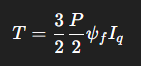
Where:
- P is the number of magnetic poles
- ψf is the magnetic flux produced by the permanent magnets
- Iq is the quadrature current component responsible for torque
This relationship shows that torque is proportional to both the permanent magnet flux and the stator current.
1.3 Electronic Control: Inverter and Sensors
To fully utilize the potential of a permanent magnet motor, an electronic control system is required. This system generates properly phase-shifted three-phase voltages and measures the rotor’s angular position to synchronize phase switching with the magnets’ positions.
Typically, a controller based on Field Oriented Control (FOC) evaluates current and rotor position to adjust the voltage delivered to the windings in real time.
2. Applications in Electric Vehicles
2.1 Why Permanent Magnet Motors Are Preferred in EVs
In recent years, electric car manufacturers have increasingly adopted permanent magnet synchronous motors for several reasons:
- High energy efficiency: Since the rotor doesn’t require excitation currents, losses are minimized.
- High power density: Compact size and low weight allow for high power output in confined spaces, crucial in EVs where space is limited.
- High torque at low speed: Ideal for rapid acceleration and maintaining strong performance at low speeds, improving urban drivability.
- Precision control: The inverter and FOC allow for highly precise operations, supporting regenerative braking and energy recovery.
3. Advantages and Limitations of Permanent Magnet Motors
3.1 Key Advantages
- High energy efficiency: No excitation losses reduces current consumption.
- Excellent power density: Low weight and compact size yield one of the best power-to-weight ratios.
- Fine load regulation: Accurate control of torque and speed, with rapid response to load variations.
- Low noise and vibration: Optimized magnet design and electronic control minimize mechanical disturbances.
3.2 Limitations and Challenges
- Material cost: Neodymium-iron-boron magnets contain expensive rare earth elements, often sourced from limited geographic areas.
- Thermal sensitivity: At high temperatures, the magnetic flux of the magnets can degrade, reducing efficiency.
- Energy recovery management: During regenerative braking, the motor acts as a generator. The electronics must be capable of handling high reverse currents.
- Waste and recycling: At vehicle end-of-life, recycling rare-earth magnets requires specific processes.
4. Debunking the “Perpetual Magnetic Motors”
4.1 What the Viral Videos Claim
Many online videos showcase devices with appealing names like “magnet motor without consumption,” “free energy magnet motor,” or “perpetual magnet engine.” Their advocates typically claim:
- A set of permanent magnets arranged to self-sustain motion.
- No need for batteries, fuel, or external current.
- The motor runs forever, producing unlimited energy to power lights, appliances, or even cars.
These videos often rely on empirical (and sometimes manipulated) demonstrations of small devices that appear to spin indefinitely once started.
4.2 Why They Violate the Laws of Physics
4.2.1 First Law of Thermodynamics (Conservation of Energy)
Statement: Energy can neither be created nor destroyed, only transformed.
Impact: A permanent magnet device does not perform work “for free.” Overcoming friction and magnetic repulsion/attraction requires energy. Videos showing endless rotation ignore mechanical losses (bearing friction, air resistance) and magnetic losses (eddy currents, hysteresis).
4.2.2 Second Law of Thermodynamics (Entropy)
Statement: In an isolated system, entropy tends to increase; no machine can operate in a cycle and produce net work without heat dissipation.
Impact: A self-sustaining motor that never stops contradicts the principle that every energy transformation increases entropy and involves losses.
None of these videos has ever validly demonstrated a closed energy balance—through measurements of magnetic field, current, voltage, and mechanical power—that results in energy “from nothing.”
4.3 Common Errors in DIY Videos
- Friction and sliding bearings: Many prototypes use low-quality bearings or special lubricants that temporarily reduce friction. The device may appear to self-power, but eventually slows and stops.
- Deceptive camera angles: Cameras often obscure interacting magnets, making it hard to judge the real forces. Some inventors add hidden levers or magnets to push the rotor.
- No power measurement: These videos often lack data from wattmeters or oscilloscopes. Without electric and mechanical input-output graphs, there’s no proof of energy gain.
- Inertia and resonance: A manual nudge may cause a rotor to spin for several rotations. The video cuts before it slows, creating the illusion of perpetual motion.
4.4 Why No Valid Scientific Evidence Exists
- No credible peer-reviewed publications: No reputable physics or engineering journal has ever published a paper confirming positive energy output from a perpetual magnet motor.
- Lack of experimental reproducibility: Independent labs trying to replicate such prototypes have never succeeded. When carefully disassembled and analyzed, no net energy production is found—only the temporary use of stored energy or inertia.
- International standards: Institutions like the IEEE affirm that perpetual energy devices are impossible within current physical laws.
5. How to Spot Hoaxes and Tips for Users
Demand measurable proof
Any claim of “free energy” must be backed by a full energy balance, and provide data graphs. If a video lacks technical data (voltages, currents, power, torque, efficiency), that’s a red flag.
Check the sources
- Verify if the inventor has published in accredited academic journals.
- Be skeptical if the claim is only supported by personal blogs or YouTube channels without peer review.
Analyze the practical context
A perpetual magnetic motor would need to compensate for all losses: friction, hysteresis, eddy currents, electrical resistance. In reality, permanent magnets still incur losses (e.g., Faraday cage rotors generate eddy currents).
Consider theoretical foundations
If a project makes no reference to core physics concepts like entropy, energy balance, or Maxwell’s laws, it’s likely just entertainment. Those who claim to break thermodynamic laws often misinterpret partial experiments.
6. Conclusions
Permanent magnet motors are currently the most widespread and mature technology in electric vehicles. Thanks to their high efficiency, power density, and precise control, they have enabled the widespread adoption of electric mobility. However, the idea of a perpetual magnetic motor that runs without any external energy source remains a fantasy, unsupported by the laws of physics. Videos attempting to prove the contrary often rely on tricks, manipulation of initial inertia, and the omission of real energy losses.
 Trust in Science