
In the vast theater of nature, every creature plays its role with unique tools: fur pigments, feathers with impossible hues, iridescent surfaces. But what appears to us as a triumph of color can be, for others, a limited mosaic—or even a chromatic desert. Let’s explore how the visual limits of other species have guided the evolution of shapes and colors able to hide, communicate, or deceive the surrounding world.
The “Invisible” Camouflage of the Tiger
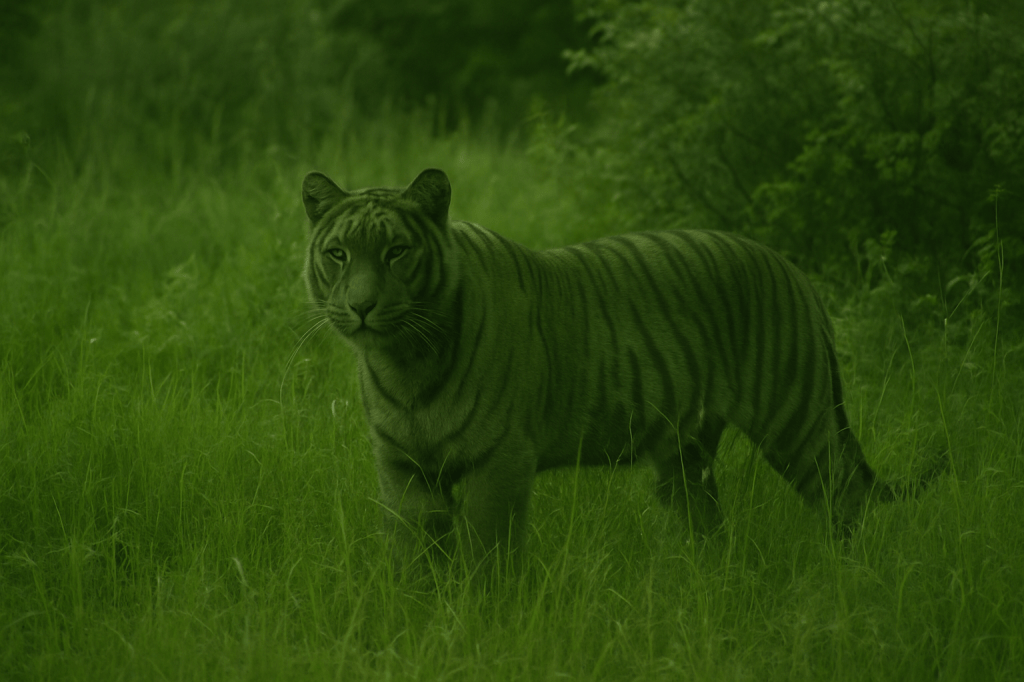
When the majestic orange of a tiger seems to clash with the green grass, in reality, to its prey—deer and antelopes with dichromatic vision—that orange appears as a shade of green-brown. The absence of cones sensitive to red and orange wavelengths transforms what is for us a flashy predator into a ghost among the bushes.
The “Secret Colors” of Birds
Many passerines have four types of cones (the basic units that enable a visual system to perceive and differentiate colors), one of which is sensitive to ultraviolet light. This allows species like the great tit to flaunt a crown of feathers that reflects intense UV—signaling vigor to potential mates but completely invisible to mammals lacking that fourth cone. An experiment showed that both sexes respond to those reflections, choosing mates with brighter UV reflections, thus turning ultraviolet glow into reproductive success.
Butterflies and Bees: UV Guidance to Flowers
Butterflies and bees paint petals with signals hidden from human eyes. Bees, equipped with photoreceptors for blue, green, and UV, are blind to red: what we see as a purple flower is a jumbled mess of grays and blacks for them. However, UV-reflective petal veins act like “directional arrows,” guiding insects to nectar and pollen along a route only they can perceive.
Beyond bees, some wasps and ants use modest UV reflections on their bodies or wings to identify as members of the same colony or to recognize social roles—communicating at close range with a “light code” that we cannot perceive.
Zebras and Mosquitoes: Striped Defense Against Disease Vectors
The iconic black-and-white stripes of zebras are not just a visual spectacle for us—they are a highly effective visual barrier against mosquitoes and other blood-feeding insects. Studies in Botswana and South Africa showed that, compared to uniform surfaces or large-scale patterns, high-contrast stripes interfere with the complex orientation and landing mechanisms of tsetse flies and sand flies, drastically reducing contact points on the animal’s skin.
This phenomenon is based on several optical and behavioral factors:
- Visual system confusion: Stripes create frequent changes in contrast and brightness, making it difficult to calculate flight speed and direction. Insects, whose vision relies on rapid light changes between frames, tend to “lose sight” of the zebra and veer off course.
- Reduced polarization perception: Many insects sensitive to light polarization navigate using uniform reflections from the host’s surface. Alternating bands disrupt these signals, weakening the zebra’s detection as a food source.
- “Spatial resonance” effect: The size and frequency of stripes fall into a “critical confusion zone”: not fine enough to appear uniform, not wide enough to form clear shapes—perfect for masking edges and contours that guide insect landings.
The protective effect of stripes is so significant that, in captivity, zebras exposed to tsetse flies generally suffer 50–70% fewer bites compared to horses or antelopes with solid-colored coats. This adaptation not only reduces discomfort and physical stress but also limits the spread of bloodborne diseases like trypanosomiasis and West Nile virus—proving how a simple natural pattern can become a remarkably effective survival strategy.
The Mantis Shrimp: A Living Prism
If you think three or four color channels are enough, the mantis shrimp will make you think again. Its compound eyes integrate 12 different types of photoreceptors for distinguishing wavelengths (from UV to red) and at least 6 more specialized in detecting polarized light. That’s roughly 18 classes of optical receptors, enabling it to “see” a chromatic and polarized signal world unimaginable to us. In an environment rich in visual signals, this ability isn’t a mere quirk: it helps differentiate species, regulate social interactions, and quickly identify prey and predators without overloading the brain.
Invisibility and Sexuality: A Delicate Balance
In nature, it’s not just about hiding. Species like the guppy display vivid colors to mates, but those hues appear muted to predators. In peacocks, the iridescence of the fan communicates elegance to females, while raptors and carnivores—less sensitive to certain shades—ignore most of that brilliance. Thus, a compromise evolves: be eye-catching to the right viewers, invisible or unappealing to the wrong ones.
Reindeer and Ultraviolet Vision: An Arctic Adaptation
In the Arctic, where the ground stays snow-covered for most of the year and the sun remains low on the horizon, the light that reaches the surface consists largely of short wavelengths, especially blue and UV. Reindeer (Rangifer tarandus) have evolved an extraordinary ability to perceive ultraviolet radiation (~320–350 nm), which transforms the landscape into a world of contrasts invisible to the naked human eye.
Thanks to UV vision, lichens and mosses—vital winter food—absorb UV and appear black against the white snow, making edible patches easier to spot. Similarly, the urine of other animals (a sign of predators or rival herds) and the dark fur of wolves and foxes, also strong UV absorbers, stand out as dark, distinguishable blotches, giving reindeer a crucial advantage in threat detection.
Another marvel is the seasonal change in the tapetum lucidum (a reflective layer behind the retina): in summer it appears greenish, in winter it turns deep blue—optimizing UV light reflection toward photoreceptors. This not only improves sensitivity in dim light but also seems to protect the eye from UV-related damage, likely through natural antioxidants and a high concentration of vitamin C in the eye tissues.
All in all, UV vision is a multifunctional adaptation: it enhances food search, predator detection, competitor awareness, and protects against “snow blindness.” This example shows how, even in an apparently monochromatic environment, evolution can sketch out new shades of survival—based on a visual world utterly different from ours.
Infrared Vision in Snakes
Some vipers and pythons (like the Gaboon viper or ball python) have thermal vision organs (loreal pits) that detect infrared radiation emitted by the body heat of prey. This thermal sixth sense is independent of traditional sight but integrates with it precisely, allowing the snake to detect small mammals in complete darkness.
Multispectral Vision in Birds of Prey: Biological Radar Eyes
Raptors like eagles, hawks, and buzzards boast a visual system we might call biological radar: their eyes don’t just capture more detail—they filter the world through multiple spectral bands to spot prey and points of interest from kilometers away.
- Two foveae for double clarity: Unlike humans with a single fovea (the retina’s high-density cone region), many raptors have two foveae per eye: a central one for high-resolution direct vision, and a lateral one for scanning the horizon during flight—key for spotting the tiniest movement.
- Ultra-dense cones and contrast perception: In these foveal zones, cone density can exceed 1,000,000 cells per mm², compared to about 200,000 in human eyes. The result is a stunning ability to detect brightness and contrast variations at the limit of visibility: a tiny mouse in a grassy field appears as a pinpoint of contrast visible from 1–2 km up.
- UV extension to “see the unseen”: Some raptors, especially buzzards and kites, have cones sensitive to ultraviolet. This lets them detect urine or fur trails left by prey on vegetation, which reflect UV differently from their surroundings—helping them track rodent paths invisible to us.
- Adaptation to high altitude and brightness: Raptors’ eyes are set deep into bony sockets and protected by nictitating membranes that regulate light entry. At high altitudes, where air is thinner and sunlight more intense, these features prevent glare and maintain a sharp image without retinal fatigue.
- Rapid brain processing: The retina’s high resolution is backed by specialized brain regions that process high-frequency visual signals—explaining their skill in following fast-moving prey mid-air and adjusting trajectory for lightning-fast attacks.
In short, raptor multispectral vision is a true optical super-system: double foveae, ultra-dense cones, UV sensitivity, and protective mechanisms—a suite of biological marvels that make these aerial predators among the most formidable observers on Earth.
Table: Visual Capabilities of Various Animal Species
| Species | Type of Vision | Colors Perceived | Colors Not Perceived |
|---|---|---|---|
| Human | Trichromatic | Red, green, blue | UV, IR |
| Dog | Dichromatic | Blue, yellow | Red, green |
| Cat | Dichromatic | Blue, green | Red |
| Deer | Dichromatic | Blue, green | Red, orange |
| Horse | Dichromatic | Blue, green | Red |
| Cow | Dichromatic | Blue, green | Red |
| Sheep | Dichromatic | Blue, green | Red |
| Goat | Dichromatic | Blue, green | Red |
| Mouse | Dichromatic | Blue, green | Red |
| Rat | Dichromatic | Blue, green | Red |
| Chicken | Tetrachromatic | UV, blue, green, red | Very limited IR perception |
| Pigeon | Tetrachromatic | UV, blue, green, red | IR |
| Indigo Bunting | Tetrachromatic UV | UV, blue, green, red | IR |
| Great Tit | Tetrachromatic UV | UV, blue, green, red | IR |
| Goldfish | Tetrachromatic | UV, blue, green, red | IR |
| Trout | Tetrachromatic UV | UV, blue, green, red | IR |
| Salmon | Tetrachromatic UV | UV, blue, green, red | IR |
| Eagle | Tetrachromatic UV | UV, blue, green, red | IR |
| Barn Owl | Monochromatic | Infrared (thermal sensitivity) | Visible colors |
| Octopus | Monochromatic | Brightness (black and white) | All colors |
| Mantis Shrimp | Polychromatic (12+) | Full UV–IR range | None |
| Bee | Trichromatic UV | UV, blue, green | Red |
| Butterfly (Monarch) | Pentachromatic UV | UV, blue, green, yellow, red | IR |
| Guppy | Trichromatic UV | UV, blue, green | Red (muted) |
| Jumping Spider | Trichromatic UV | UV, blue, green | Red |
| Crow | Tetrachromatic UV | UV, blue, green, red | IR |
| Lynx | Dichromatic | Blue, green | Red |
| Fox | Dichromatic | Blue, green | Red |
| Gazelle | Dichromatic | Blue, green | Red |
| Zebra | Dichromatic | Blue, green | Red |
| Hippopotamus | Dichromatic | Blue, green | Red |
| Rhinoceros | Dichromatic | Blue, green | Red |
| Chameleon | Trichromatic | Red, green, blue | Limited UV |
| Peacock | Tetrachromatic UV | UV, blue, green, red | IR |
Note: “UV” indicates ultraviolet range; “IR” indicates infrared. In many species, IR sensitivity is very limited. The vision type (mono-, di-, tri-, tetra-, polychromatic) summarizes the richness of their visual spectrum.
 Trust in Science