
Around 6 million years ago, during the late Miocene, the Mediterranean Sea underwent one of the most extreme transformations in Earth’s history. A combination of tectonic shifts and changes in sea levels led to the closure of its connection to the Atlantic Ocean, cutting off the steady flow of water that had sustained it. Without this supply, the Mediterranean began to evaporate under the region’s hot, dry climate, and over time, vast portions of the sea floor were left exposed. This period, known as the Messinian Salinity Crisis, lasted for several hundred thousand years and dramatically altered the landscape of southern Europe and North Africa.
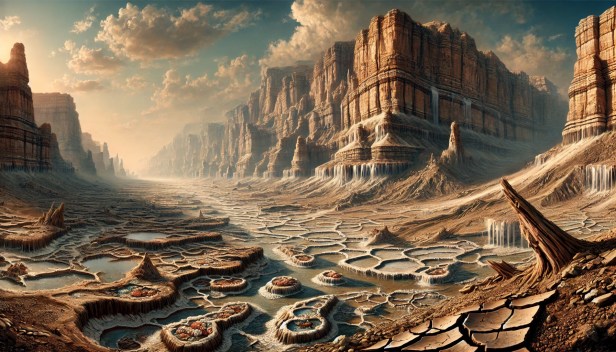
Rather than the familiar deep blue waters of today, the Mediterranean basin became a barren, salt-encrusted expanse. Immense salt flats and dry lake beds stretched for miles, creating an environment reminiscent of modern-day Death Valley or the salt flats of Bolivia. Some scientists believe that scattered lakes and briny marshes may have persisted in the deepest depressions, where the last remnants of water collected. However, for the most part, the region was likely an extreme, inhospitable desert, with temperatures soaring and little vegetation to sustain life.
Animals and plants
Despite these extreme conditions, some plants and animals managed to survive along the edges of the basin. Fossil evidence suggests that drought-resistant plants may have been present in areas where groundwater was still accessible. The fauna was likely sparse, limited to migratory species or animals capable of enduring long periods without water. However, even large mammals, such as ancient relatives of elephants and antelopes, roamed what was once the seafloor. One of the most fascinating aspects is that the drying up of the Mediterranean may have facilitated the migration of species between Africa and Europe. During the Messinian Salinity Crisis, the exposed land could have served as natural bridges between the two continents. Some African mammals may have crossed the dried Mediterranean to reach Europe and vice versa, and there are various sources of evidence that help reconstruct what happened during the sea’s desiccation. For example, fossils of primitive elephants, antelopes, and other mammals have been found in Messinian sediments in Spain, Italy, Greece, and North Africa. In Sicily, remains of ancient mammals that lived in the Mediterranean before the reflooding have been discovered.
Furthermore, oceanographic research has allowed scientists to collect sediment samples from the Mediterranean seafloor. In the 1970s, the Deep Sea Drilling Project (DSDP) drilled into the seabed and discovered thick layers of evaporites (salts deposited by seawater evaporation). In some areas, beneath these layers, fluvial or lacustrine sediments were found, indicating the presence of rivers or temporary lakes that could have been inhabited by terrestrial fauna. Exploration of the seabed using sonar and underwater robots has revealed the presence of deep canyons and ancient riverbeds that once ran through the Mediterranean during its arid phase. Among the most notable are the submerged Nile Canyon, which once flowed at a much lower level than today, and the Rhône Canyon in France. These rivers could have supported life and facilitated the movement of animals.
The Flood
This desolate phase came to an abrupt and dramatic end when the Mediterranean reconnected with the Atlantic Ocean in an event known as the Zanclean Flood. Geological evidence suggests that the barrier at the Strait of Gibraltar eroded or was breached, allowing water to rush in with unimaginable force. The refilling may have taken place in as little as a few months to a few years, with waterfalls possibly miles wide and thousands of times more powerful than Niagara Falls. The force of the water carved deep underwater canyons, scouring and reshaping the landscape beneath the waves. Some of these canyons, including the Strait of Sicily and deep channels off the coasts of Spain and France, remain visible on the seafloor today.
With the return of water, marine life quickly recolonized the Mediterranean. Fish, molluscs, and other sea creatures migrated from the Atlantic, re-establishing an ecosystem that had been lost for hundreds of thousands of years. Over time, the sea stabilized, and the Mediterranean took on the form we recognize today. This transformation would later play a crucial role in human history, as the region became a cradle of civilization, supporting some of the greatest cultures of the ancient world.
Although much is known about the Messinian Salinity Crisis and the Zanclean Flood, scientists continue to investigate the details of this remarkable event. The question of whether parts of the Mediterranean basin supported life during its dry phase is still debated, and new fossil discoveries could help reveal more about what this strange landscape looked like. Regardless of the uncertainties, the story of how an entire sea vanished and then returned in a cataclysmic flood remains one of the most fascinating episodes in Earth’s geological history.
 Trust in Science