
Cosmic Rain: The Space Dust Falling on Earth
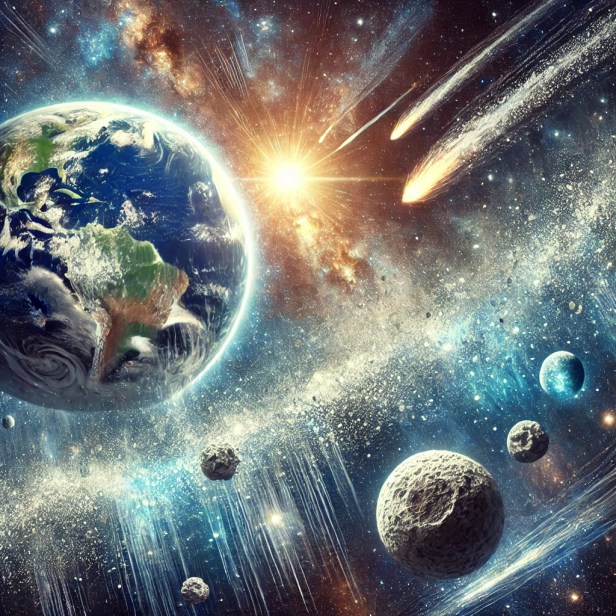
Every day, our planet is bombarded by cosmic dust, a constant influx of tiny particles from space. This dust originates mainly from comets, which shed material as they approach the Sun, and from collisions between asteroids, which produce fragments that spread throughout the solar system. This phenomenon has been ongoing for billions of years and continues to affect the entire globe. Larger fragments of extraterrestrial material, such as rocks and metals, produce spectacular luminous trails as they pass through the atmosphere, while the smallest ones reach the surface as microscopic dust.
Accurately measuring this cosmic rain is a scientific challenge, as terrestrial dust tends to mix with extraterrestrial particles. However, Antarctica, with its geographic isolation and perennial ice, serves as an ideal reservoir for studying micrometeorites. The annual layers of snow allow scientists to date the deposits, minimizing terrestrial contamination. A recent study conducted in this region estimates that about 5,200 metric tons of cosmic dust fall on Earth each year. More than 60% of this dust likely originates from comets belonging to the Jupiter family, while around 20% comes from the asteroid belt. Cometary particles, often softer and rich in organic compounds, may have been crucial to the emergence of life on our planet.
The Moon’s Retreat: A Slow Cosmic Farewell
The Moon is gradually moving away from Earth at a rate of about 3.78 centimeters per year, a seemingly small shift that carries significant long-term implications. This gradual retreat affects tidal patterns and the length of Earth’s day, and in the distant future, it will lead to a synchronous Earth-Moon rotation where one side of the planet will always face the Moon. But why does this happen? The answer lies in the conservation of angular momentum. The Moon’s gravity creates tidal forces that deform Earth’s surface, especially its oceans, gradually slowing the planet’s rotation. To compensate for this loss of rotational energy, the Moon accelerates and moves into a larger orbit.
If this trend continues, in approximately 50 billion years, the Earth-Moon system will reach a synchronous rotation. At that point, the Moon will be visible only from one hemisphere of the Earth, while the other half will remain perpetually without it. However, long before this scenario unfolds, the Sun will have exhausted its nuclear fuel and become a white dwarf, making the survival of both celestial bodies unlikely.
The Origin of Earth’s Water: A Mystery to Unravel
Water, the element essential for life, has a fascinating cosmic history that not only traces the origins of our planet’s oceans but also holds the key to understanding the potential for life elsewhere in the universe. Around 4 billion years ago, during the period known as the Late Heavy Bombardment, Earth was struck by a rain of comets and asteroids. These celestial bodies, rich in ice and hydrated minerals, likely delivered vast quantities of water and volatile materials.
Isotopic studies of Earth’s water reveal similarities with that found in comets from the Jupiter family, but not all comets match this isotopic signature, leaving the question open. Asteroids, particularly those from the main belt between Mars and Jupiter, have also been identified as potential water sources. Other researchers suggest that water may have formed directly on Earth through chemical reactions in the protoplanetary disk, making a combination of origins likely for this precious resource.
The Vastness of the Universe
The universe is vast beyond imagination. Current estimates suggest it contains about 2 trillion galaxies, a figure based on observations of the nearby universe made possible by advances in telescope technology. Over the past decades, increasingly powerful instruments, such as the Hubble Space Telescope and next-generation observatories like the James Webb Space Telescope, have dramatically expanded our understanding, revealing previously unseen cosmic structures and pushing the boundaries of the observable universe. Each galaxy can host hundreds of billions of stars; for example, our Milky Way contains approximately 400 billion stars. Crossing a galaxy would take 100,000 years traveling at the speed of light.
The number of stars in the observable universe exceeds the number of grains of sand on all the beaches of Earth. Advances in telescope technology continue to push the boundaries of our knowledge, revealing ever more details of an ever-expanding cosmos.
Why Does the Sun Appear Yellow?
Although we perceive the Sun as yellow, its light is actually white, as it contains a balanced combination of all colors in the visible spectrum. When viewed from space, without atmospheric interference, the Sun appears white. The yellowish hue seen from Earth is caused by atmospheric scattering, which preferentially redirects shorter wavelengths like blue and violet, leaving the longer wavelengths, including yellow and red, more prominent to our eyes. This color results from the combination of all visible wavelengths. However, Earth’s atmosphere scatters blue light more effectively than other wavelengths, making the sky appear blue and the Sun yellow or orange, especially when it is near the horizon.
 Trust in Science
Wonderful post🌅🌅
"Mi piace""Mi piace"