
Earth is often described as a paradise for life, but the reality is far more complex. Our position in the universe is remarkably favorable, yet fragile. Even small variations could lead to catastrophic consequences.
The Relationship with Other Celestial Bodies
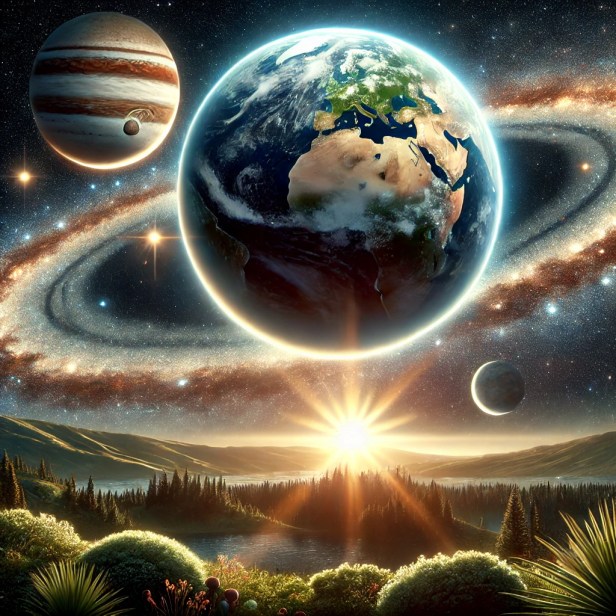
Earth resides in the so-called habitable zone, a distance from the Sun that allows for liquid water. However, if we were slightly closer or farther, the climate would change significantly: higher or lower temperatures would make the planet less hospitable, though not instantly uninhabitable. The speed of Earth’s rotation is another critical factor. A faster rotation would lead to stronger winds and shorter days, while a slower rotation would increase temperature differences between day and night, creating more extreme climates.
The presence of the Moon contributes to the stability of Earth’s axial tilt, preventing excessive oscillations that could disrupt the climate. Additionally, lunar tides help mix ocean waters, preventing stagnation that could threaten marine biodiversity.
Lastly, Jupiter plays a vital role as a gravitational shield, deflecting asteroids and comets that might otherwise strike Earth. Without this gas giant, the frequency of catastrophic impacts on the inner planets would be much higher.
A Hostile Planet
Despite these protections, Earth is not entirely hospitable. Hurricanes, earthquakes, volcanic eruptions, and asteroid impacts constantly threaten life. Fossil records show that 99% of all species that ever lived on our planet have gone extinct. Moreover, a human exposed to Earth’s environment without protection would die in 75% of locations within ten minutes due to predators or extreme weather conditions (The Independent, 2020).
Is There Something Better Than Earth?
Recent research suggests that Earth may not be the best possible planet for life. Scientists have identified 24 planets that appear to offer even more favorable conditions for hosting life than our world.
A New Concept: Superhabitability
The term “superhabitable” describes worlds that may have better conditions than Earth for the development and maintenance of life. Researchers examined over 4,500 known exoplanets, analysing criteria such as size, age, temperature, water availability, and the type of star they orbit.
A key aspect of the research was selecting host stars. Stars similar to our Sun (known as G-type stars) have a relatively short lifespan on a cosmic scale. Since complex life on Earth emerged after nearly half of its usable life, many G-type stars could burn out before complex life has time to evolve. In contrast, K-type stars, which are smaller and longer-lived, can last up to 70 billion years, providing much more time for complex organisms to develop.
Characteristics of a Superhabitable Planet
Superhabitable planets are larger than Earth — about 10% bigger — offering more surface area for life. A larger mass also ensures a longer-lasting active core and stronger gravity, capable of retaining a protective atmosphere. Temperature is another key factor: a planet with an average temperature about 5°C higher than Earth’s could be more hospitable. Additionally, having more water, distributed as widespread humidity rather than vast oceans, would enhance the liveability of a planet.
Study Results
None of the 24 planets identified meet all ideal characteristics simultaneously. However, one of these worlds possesses at least four of the desirable traits, making it a particularly intriguing candidate for further study.
All these planets are located more than 100 light-years away, making direct exploration currently impossible. However, next-generation telescopes, such as NASA’s James Webb Space Telescope, LUVIOR, and the European Space Agency’s PLATO, could allow us to obtain more detailed images and even detect potential signs of life.
Professor Dirk Schulze-Makuch, who led the study, emphasizes the importance of broadening our horizons: “We should not restrict ourselves to searching for a second Earth. There may be planets even better suited for life than ours”. This perspective could shape future space exploration, guiding us toward worlds where life might thrive in ways we can’t yet imagine.
Sources
www.independent.co.uk/space/earth-alien-life-nasa-planets-worlds-b811661.html
 Trust in Science