
Imagine a world where the fabric of space and time bends, stretches, and curves, dictating the motion of everything within it. This is the profound vision Albert Einstein presented to humanity with his General Theory of Relativity in 1915. More than a century later, this theory remains one of the cornerstones of modern physics, reshaping our understanding of gravity, the cosmos, and even time itself.
The Birth of a Revolutionary Idea
Before Einstein, gravity was described by Isaac Newton as a force pulling objects toward one another. Newton’s equations worked exceptionally well for everyday phenomena, from apples falling to Earth to the motion of planets. However, they offered no insight into why gravity exists or how it propagates through the void of space.
Einstein’s epiphany came from a deceptively simple thought experiment: he imagined a person falling freely from a rooftop. In freefall, the person wouldn’t feel their own weight. This led Einstein to a profound realization: gravity isn’t a force in the traditional sense but a manifestation of how mass and energy distort the fabric of space and time, or spacetime.
The Fabric of Spacetime
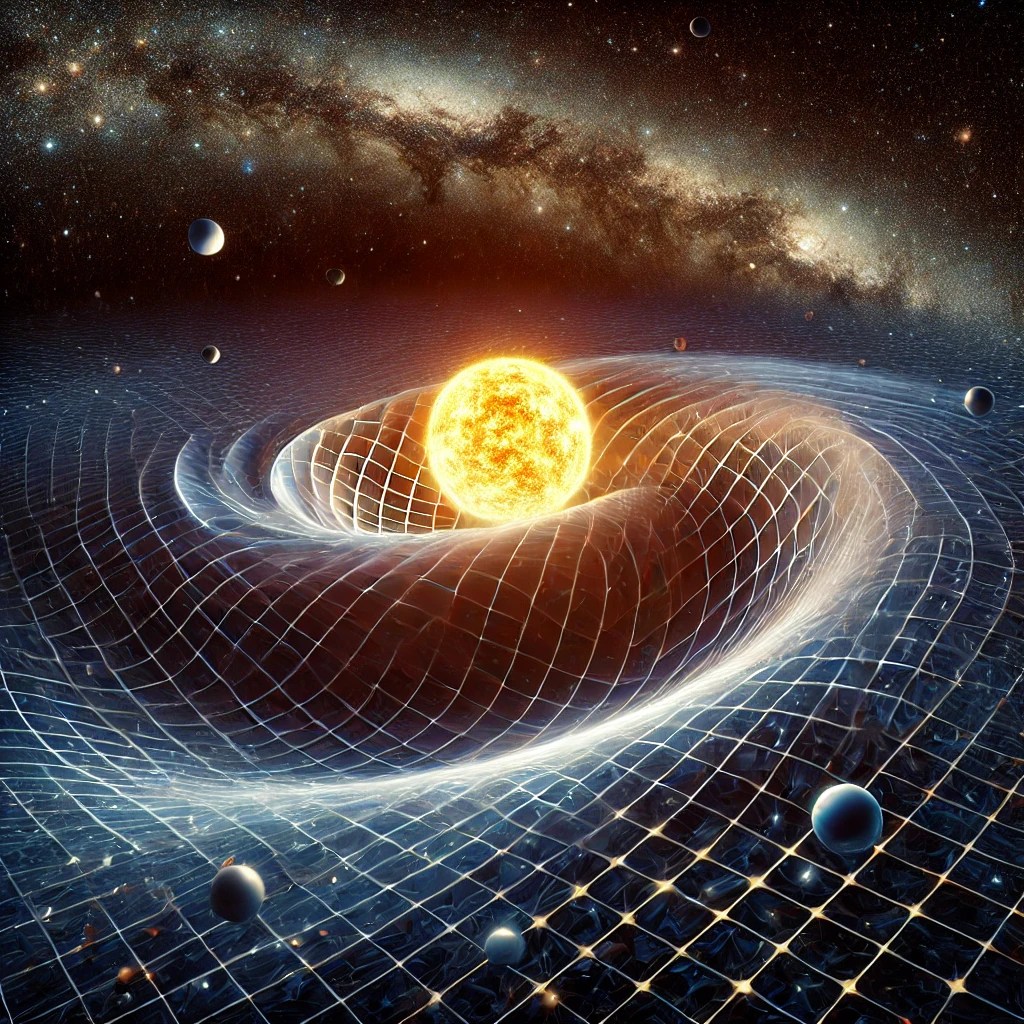
In Einstein’s universe, spacetime is a four-dimensional continuum, combining the three dimensions of space with time as the fourth dimension. Massive objects like the Sun create a dent or curve in this spacetime fabric. Smaller objects, like planets, move along these curves, much like marbles rolling around a dip on a stretched-out sheet. What we perceive as gravity is simply the motion of objects following these curved paths.
How Does Spacetime Curvature Work?
To visualize spacetime curvature, imagine a stretched rubber sheet representing the fabric of spacetime. When you place a heavy object, like a bowling ball, in the centre of the sheet, it creates a dip or indentation. This dip represents the distortion caused by a massive object in spacetime. If you roll smaller balls (representing planets or asteroids) across the sheet, their paths will bend as they move around the indentation. This bending mimics how gravity influences the motion of objects.
Importantly, spacetime curvature isn’t limited to the surface analogy. It occurs in all three spatial dimensions plus time. This means the distortion extends outward in every direction around a massive object. Time itself also becomes affected, running slower in regions of stronger gravity — a phenomenon known as time dilation.
Everyday Examples of Spacetime Distortion
- Earth and Satellites: Earth’s mass creates a curvature in spacetime that keeps the Moon in orbit and pulls objects toward the ground. GPS satellites must account for both the curvature of spacetime and time dilation to provide accurate positioning data.
- The Sun’s Influence: The Sun’s immense mass creates a deep well in spacetime, guiding planets in their orbits. Without this curvature, planets would move in straight lines and drift away into space.
- Black Holes: Black holes are extreme examples of spacetime distortion. Their mass is so concentrated that they create an infinitely deep well in spacetime, preventing even light from escaping. This leads to the formation of an event horizon, beyond which nothing can return.
Why Does Spacetime Curve?
Einstein’s field equations describe how mass and energy tell spacetime how to curve. The greater the mass or energy of an object, the more significant the curvature it creates. This relationship is mathematically represented by the Einstein Field Equations, a set of complex equations that link the distribution of matter and energy to the geometry of spacetime.
Predictions and Proof
The General Theory of Relativity was ground-breaking not just in concept but also in its predictive power. Einstein’s equations have led to several key predictions, many of which have since been confirmed through experiments and observations:
- Mercury’s Orbit: Einstein’s theory explained the peculiar wobble in Mercury’s orbit around the Sun, which Newtonian physics couldn’t fully account for.
- Gravitational Lensing: Massive objects, like galaxies, can bend light from distant stars, acting as cosmic magnifying glasses. This phenomenon, known as gravitational lensing, was observed during a solar eclipse in 1919, providing one of the first confirmations of Einstein’s theory.
- Gravitational Waves: Einstein predicted ripples in spacetime caused by massive accelerating objects, like colliding black holes. These waves were directly detected for the first time in 2015 by the LIGO observatory, a century after Einstein’s prediction.
- Time Dilation: The theory predicts that time runs slower in stronger gravitational fields. This effect, known as gravitational time dilation, has been confirmed through experiments using atomic clocks on Earth and aboard satellites.
Implications for the Universe
The General Theory of Relativity isn’t just about gravity; it’s a window into the nature of reality. As already mentioned, it’s essential for understanding black holes; moreover, it also underpins the Big Bang theory, describing how the universe has been expanding from an incredibly dense and hot initial state.
Einstein’s equations have even shaped our modern technologies. GPS systems, for example, must account for time dilation due to Earth’s gravity to provide accurate location data.
A Century of Exploration
More than 100 years after its publication, the General Theory of Relativity continues to inspire. Its predictions are being tested at ever-increasing levels of precision, and its concepts influence fields as diverse as quantum mechanics and cosmology. Einstein’s insights remind us that the universe is not just a collection of objects in space but a dynamic, interconnected tapestry of space, time, matter, and energy.
Einstein once said, “Imagination is more important than knowledge.” The General Theory of Relativity exemplifies this sentiment, born from a simple yet profound thought experiment that forever changed how we see the cosmos. As we delve deeper into its mysteries, we continue to marvel at the elegance and depth of Einstein’s masterpiece.
 Trust in Science